Tuesday, June 10, 2014

TOW #30

Dear up and coming Advance Placement English Language & Composition (APELEC) students.  The days ahead will require hard work, dedication and the will power of a reformed alcoholic.  Don’t worry.  It will all be worth it in the end.  Your ambition and purpose in this class should not be to get an “A” but to improve your skills as a writer.  If your purpose for taking this class is to “fluff up” your college application, you might want to reassess your situation.  Many of the colleges you will most likely apply to will not even accept an AP exam score of a 5.  The reasoning behind this is beyond me but it really puts this class into perspective.  The purpose for taking this class is to focus on your writing.  If you do not keep this in mind you will never improve, you will never succeed and you will never be able to live up to the standards that are required of you.
Now, I’m not trying to scare you into dropping this class or am I trying to discourage you.  This is just a wakeup call.  I can promise you that you have never experienced any thing as demanding as this course but the truth is, you can handle it.  As long as your writing comes first, and your grade second, you will be satisfied with yourself in this class.  The first grade you are going to receive in this class will, and should, be your worst grade of the year.  It will be full of notes and critiques written in a deep colored red pen.  Don’t let this discourage you.  Rather, let it motivate you.  Every note, mark and critique that Mr. Yost, Ms. Pronko or your fellow classmate scribble onto your paper is written with the intent to improve your writing.  Don’t be ashamed of these mistakes.  Use this constructive criticism to your advantage.  Better yourself as a writer and figure out how you can keep these mistakes from happening.  Never be afraid of someone catching a mistake in your work.  In fact you should be looking forward to your work being scrutinized.  For every mistake that is caught and corrected there will be one less mistake on your next paper making your writing that much better.  After all, isn’t that why you took this course in the first place?

            Good luck and happy writing, Aaron Pieroni

Tuesday, June 3, 2014

Tow #29 Born into Brothels: Zana Briski

Tow #29 Born into Brothels: Zana Briski
           
            In her documentary, Born into Brothels, Zana Briski demonstrates the changing lives of the young red light district children as their lives were exposed to the world of art and photography.  This transition in the documentary helps Briski assert her claim that art has the ability to change the lives of troubled individuals.  In her documentary Briski teaches the children about photography and within a short period of time some of them are able to sell their pictures and are able to use this money to seek out a better education and a better life for themselves.  However, many of the children are forced to stay within the brothels because of stress of the new education systems, the long distance from home and from the incredulous bidding of ignorant parents.  Despite these hurdles these children will still have the memories and the reality escape that art brings, forever changing their lives.  In today’s society many therapists and doctors understand the healing power and mental release that art brings.
            In many rehab centers addicts are encouraged to express their feelings through art.  Art in this context is a great healing method.  It allows the artist to create something that is theirs, something they can control.  An aspect of many addicts lives that they have very little off because of their dependency on drugs and other methods of satisfaction.  For many addicts this proves to be beneficial in controlling their addiction. 

            In these ways art can be a means of which to escape reality, to take grasp and control of your current one or as a way to pull yourself up by your bootstraps and better your life. 

Tuesday, May 27, 2014

TOW #28 Born into Brothels: Zana Briski

TOW #28 Born into Brothels: Zana Briski
Born into Brothels is a documentary directed by Zana Briski, a photographer and filmmaker who uses art to change the lives of many people.  The goal of Born into Brotherls was to show case to the world the children living in Sonagachi, Kolkata’s red light district.  The documentary shows the development of a relationship between Briski and the children.  This relationship starts out when she decides to teach some of the children living within the brothels photography, but develops into a mother-child relationship.  This is demonstrated by the way the children refer to her as “auntie” not as “teacher” or “Ms”.  As Briski gets more involved in the children’s lives she takes them on various trips to the zoo, to the shore and some even got to go to foreign countries because of their photography that she showcased.  By selling the children’s photography Briski was able to bring a few of these children out of poverty and into boarding schools where they may have a future with their education.
Briski’s purpose seemed to develop throughout the documentary.  Obviously she was ultimately trying to show the western world the terrible conditions in which these children lived, but it developed into something more then that.  Briski’s documentary really demonstrated how art, how photography can change lives.  Many of these children never held a camera before Briski came along but after a shirt time with her they became internationally known. 

Throughout the documentary the music was used to set the mood.  Often dark and menacing when in the brothels but then more up-beat once hope was introduced.  This hope being anytime the children went out shooting pictures or when they were arriving at school the first time.  This use of similarly happy, up-beat music during the visit to school and the various photography excursions allowed the viewer/listener to associate the hope school offers with photography.  This allows for Briski’s purpose to be brought forward because the viwer/listener now can assume (rightly so) that photography was the hope, and the ticket to freedom, these children were looking for. 

Tuesday, May 20, 2014

TOW #27 Reflection

I have noticed that my TOW responses have progressed significantly throughout the course of this year.  In the beginning of the year a majority of my TOW posts involved current events and non-educational topics and did little to further my development as a writer and a thinker.  Recently I have began to read more in-depth and unusual pieces.  Currently i'm reading an instruction book written in the 80s about bonsai art.  Contrasting sharply with the more entertaining book I read in the beginning of the year, the memoirs of Casanova.  MyTOWs themselves are more structured and now focus more on analysis rather then the summation of the topic.  I believe this structuring is something I have learned to master and now my TOWs are written more coherently. Conveying my message more effectively.  I also believe that my analysis is still lacking and I often fail to lead evidence into a more smooth point.  This is due to the fact that I never explain my "evidence" because I often assume the reader makes the same connection I do, which defeats the purpose of analysis.  I benefitted greatly from these TOW posts.  They forced me to read writing pieces I usually don't read and seek out rhetorical devices and strategies I overlook when I read for pleasure.  Overall the TOW posts were an effective practice measure to prepare me for the AP Exam.

Sunday, May 4, 2014

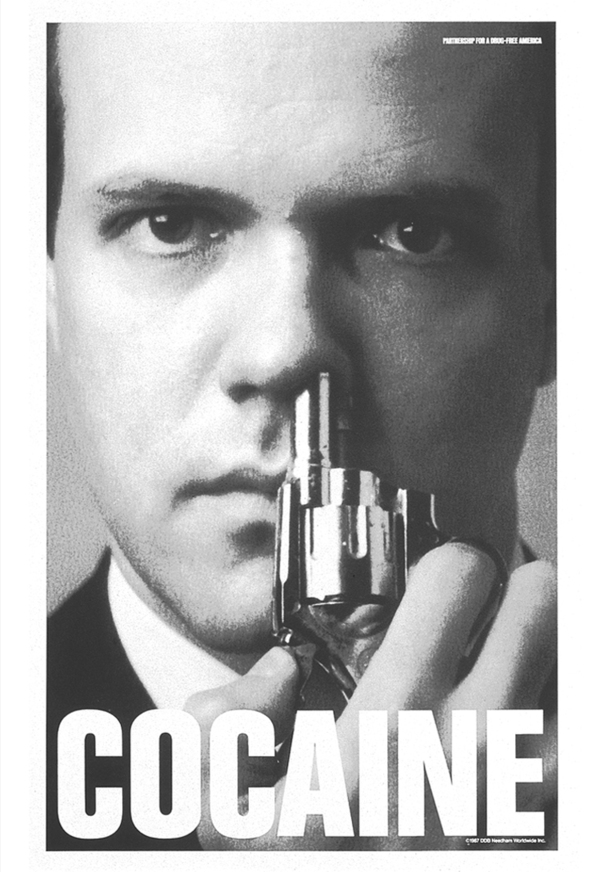
TOW #27 Visual Text: Cocaine


TOW #27
            Cocaine is a drug that is obtained from the leaves of the coca plant, which gives users a euphoric high.  Making the user feel like they are “on top of the world” for a short period of time spiraling into deep depression once off the high, which ultimately leads to a high level of dependency.  Cocaine use and dependency can lead to many side effects that can lead to sudden death such as heart attack, stroke, seizure and respiratory failure.  Despite these dangers cocaine use saw a spike in popularity during the late 1970s and 1980s where it was seen as glamorous or “high class” to use cocaine in the “yuppie” class.  It was often associated with wealth, power and prestige because of its high price and use by celebrities, which only added to the difficulty of its prohibition.
            So organizations such as the Partnership For a Drug-Free America had to resort to drastic measures to convince the youth and young adults of America that cocaine use is a lot harmful then many of them believe.  In their poster (below) they use a blunt comparison between a gun and a bump (a snort of a drug, typically cocaine).  This comparison is effective because it compares a gun, a swift deadly unbending force, with cocaine.  Inferring, without words, that shooting yourself with a gun is a dumb or as terminal as using cocaine.  In this way this comparison is effective in conveying the deadly power of such a drug.  Another, more subconscious device, is the dress and appearance of the man in the poster.  His dress and appearance clearly is modeled after the yuppie stereotype of the time; young, white, well dressed, etc.  This resemblance helps relate to the poster’s audience because many of the individuals who are using cocaine currently most likely appeal to the yuppie subculture and lifestyle. 
             Partnership for a Drug-Free America (PDFA) was a non-profit organization based in New York City, now known as The Partnership at Drugfree.org, which runs campaigns against drug abuse in the United States


Image Source
http://www.drugfree.org/

Sunday, April 27, 2014

TOW #26


TOW #26

With President Barack Obama’s presidency coming to a mid way point many individuals have voiced their disapproval in his ability to lead.  One of the most talked about points in his presidency is his weakness in foreign policy.  From Syria and Iran to Syria and Russia, the past six years has been undoubtedly rough on his presidency.    In many of these situations the President has been characterized as weak, incompetent and malleable.  Often due to his inability to get congress to agree and his isolationist attitude.
However, Ali Wyne, of The Boston Globe, does not believe we can predict how Obama will be viewed in years to come because we have not seen the full effect of his current decisions.  Too display this possibility too many staunch Obama critics Wyne compares the perceived foreign policy strength of Obama against Ronald Reagan, who is most remembered for being strong willed and persistent in international matters.  Wyne explains how Reagan signed the 1987 Intermediate-Range Nuclear Forces Treaty, simultaneously aiding Soviet Union from internal collapse, which is the opposite of what America wanted; the complete collapse of the Soviet Union.  Due to this signing Reagan was met with harsh critiscisim.  He was described as a weak man and a “useful idiot for soviet propaganda”, a sharp contrast to his perceived strength and fortitude in foreign policy that he is known for today.  Later, one of Reagan’s critics, Norman Podhoretz (editor of the journal Commentary and writer for the Times), came out later in 2006 stating that he reconsidered his previous position and now realized “Reagan’s actions formed ‘a series of prudential tactics within an overall strategy that in the end succeeded in attaining its great objective.’…the dissolution of the Soviet Union.” From the transformation of the perception of Reagan’s foreign policy we can now understand 

http://c.o0bg.com/rf/image_371w/Boston/2011-2020/2014/04/14/BostonGlobe.com/EditorialOpinion/Images/0427oped_wyne.jpg
http://www.bostonglobe.com/opinion/editorials/2014/04/26/how-will-history-remember-obama-foreign-policy/PeoXC71DJU51A85QKnHIOP/story.html

Wednesday, April 23, 2014

IRB #4

IRB Intro #4 Bonsai: The Complete Guide to Art & Technique Paul Lasniewicz

            The book that I chose for this marking period’s IRB is Bonsai: The Complete Guide to Art & Technique, written by Paul Lasniewicz.  This book is a collection of techniques, general information and theory.  All collected and conceived by Paul Lasniewicz, a known German bonsai artist who has written many books on this craft.  I have decided to use this as my IRB because bonsai has always been a hobby of mine and this book is unlike any of my previous IRBs.