TOW#5
Poème sur le désastre
de Lisbonne (Poem On The Lisbon Disaster): François-Marie (Voltaire) Arouet
On
November 1 1755 an earthquake, centered in the Atlantic Ocean, decimated the
Portuguese city of Lisbon killing an estimated 60,000 people. This colossal earthquake and the 400ft
tsunami and fires that followed destroyed two thirds of the city. Not only did this magnitude 9
earthquake send shockwaves through out continental Europe it also sent
shockwaves through European literature, art and philosophy. One of these philosophers was François-Marie Arouet more
commonly known as Voltaire who wrote the Poème
sur le désastre de Lisbonne (Poem on the Lisbon Disaster.)
Voltaire uses this poem to convey
his feelings about religion and the existence of God to the intellectual
community. In this time in
history many people believe in the existence of God and that God intervenes in
the lives of the human race. Voltaire
is the odd-philosopher-out in this time because he, while he still believes in
God, believes that God has no effect on the lives of man on earth and that
suffering is a part of life that God won’t change. Voltaire is effect in conveying this idea because of his use
of question and answer in his poem as well as by his use of vivid imagery. In one instance Voltaire states:
Come, ye philosophers, who cry,
"All's well,"
And contemplate this ruin of a
world.
Behold these shreds and cinders of
your race,
This child and mother heaped in
common wreck,
These scattered limbs beneath the
marble shafts.
Voltaire attacks the popular phase “all’s well” by painting
this graphic image of the masses of innocent people that were killed in the
Lisbon earthquake. Imagery such as
this displays, to the reader, how humans are released to suffering, despite
god’s existence, and that all is not well in the world. Later through out the poem Voltaire use
question and answer, with his own addition of another question preceding the
quote, to debate god’s true role in life, as well as some other highly debated
topics of the time. Voltaire was a
French native who lived in Europe in the 16th and 17th century. Voltaire is known for being one of France’s
most enlightened writers and for his epic poems Henriade (1723) and The Maid
of Orleans.
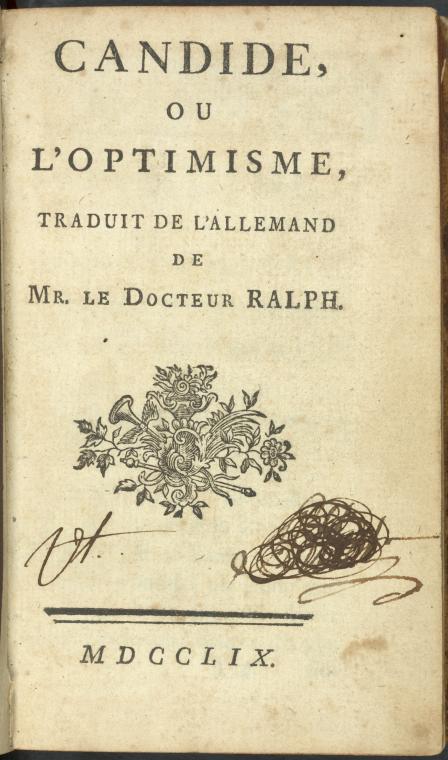 |
| Voltaire's Poem On The Lisbon Disaster is regarded to be an introduction to this book; Candide |

No comments:
Post a Comment